
If you are a shipper, owner-operator, or someone new to logistics, you have probably asked yourself: What is the going rate per mile for trucking? Understanding current per-mile rates is critical for budgeting, negotiating contracts, and running a profitable operation. This guide explains real-world averages, cost drivers, and practical ways to estimate fair trucking rates in the United States.
What Is the Going Rate Per Mile for Trucking?
The most common People Also Ask question is straightforward: What do trucking companies charge per mile?
Read too: Top Trucking Companies That Still Have Manual Transmissions
In the US market, the going rate per mile for trucking typically ranges from $1.80 to $3.50 per mile, depending on freight type, region, and market conditions.
Average market ranges (all-in, including fuel):
- Dry van: $2.00 – $2.80 per mile
- Flatbed: $2.50 – $3.50 per mile
- Reefer (refrigerated): $2.60 – $3.75 per mile
These figures represent spot market averages, not guaranteed contract rates.
Why Does the Rate Per Mile for Trucking Vary So Much?
Many readers wonder why trucking rates are not fixed. The answer lies in operational costs and market demand.
Key factors that influence trucking rates
- Fuel prices: Can account for up to 30–40% of total operating costs
- Equipment type: Reefers and flatbeds cost more to operate
- Distance & lanes: Long-haul lanes often pay less per mile than short-haul
- Seasonality: Rates rise during peak shipping seasons
- Supply & demand: Fewer trucks = higher rates
According to industry cost studies, even a $0.30 change per mile can decide whether a trucker operates at a profit or a loss.
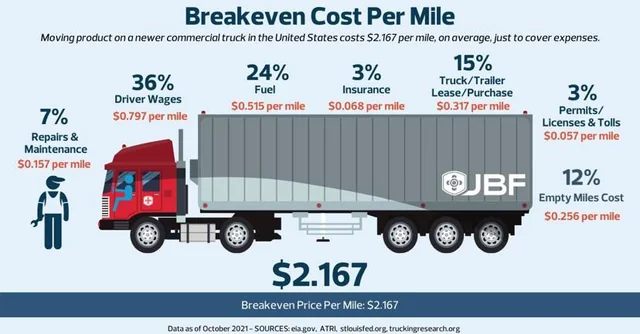
Average Cost Per Mile for Trucking (Owner-Operators)
Another frequent question is: How much does it actually cost to run a truck per mile?
For owner-operators, the average operating cost ranges from $1.65 to $2.05 per mile.
Typical cost breakdown (per mile)
- Fuel: $0.60 – $0.80
- Truck payment or lease: $0.25 – $0.35
- Maintenance & tires: $0.15 – $0.20
- Insurance: $0.10 – $0.15
- Permits, tolls, compliance: $0.05 – $0.10
👉 This means a truck earning less than $2.00 per mile may struggle to remain profitable long term.
Spot Market vs Contract Rates: What’s the Difference?
A very common question is: Are contract rates better than spot rates?
Spot market rates
Pros
- Higher upside during peak demand
- Flexible load selection
Cons
- Volatile pricing
- Income instability
Contract rates
Pros
- Predictable income
- Easier cash-flow planning
Cons
- Lower peak earnings
- Locked pricing
Expert insight: Many successful carriers balance 60–70% contract freight with spot market loads to reduce risk while maximizing profit.
Going Rate Per Mile by Truck Type
Not all trucks earn the same. Here’s a simplified comparison:
Dry Van
- Most common freight type
- Lower operating costs
- Moderate rates
Flatbed
- Higher rates due to load complexity
- More physical labor
- Seasonal demand spikes
Reefer
- Highest operational cost
- Temperature-controlled freight
- Premium pricing
This explains why reefer rates can exceed $3.50 per mile, even when dry van rates soften.
How to Calculate a Fair Trucking Rate Per Mile
Many users ask: How do I calculate my own rate per mile?
Here is a simple step-by-step method.
Step 1: Calculate total monthly expenses
Example:
- Monthly costs: $9,000
Step 2: Estimate monthly miles
- Average: 10,000 miles
Step 3: Divide costs by miles
- $9,000 ÷ 10,000 = $0.90 per mile (fixed costs)
Step 4: Add variable costs
- Fuel + maintenance: $0.80 per mile
Step 5: Add profit margin
- Desired profit: $0.40 per mile
✅ Target rate: $2.10 per mile
This approach ensures you are not underpricing your service.
Are Trucking Rates Going Up or Down?
This is one of the most searched questions in logistics.
Short answer: Trucking rates move in cycles.
- During freight booms, rates can exceed $4.00 per mile
- During slowdowns, rates may drop below $2.00 per mile
Historically, the US trucking industry follows economic trends closely. Freight demand typically rises with consumer spending and industrial output.
Common Mistakes When Evaluating Rate Per Mile
Many beginners focus only on the headline number.
❌ Ignoring deadhead miles
❌ Forgetting insurance and compliance costs
❌ Not adjusting for regional fuel prices
❌ Accepting low rates “just to stay moving”
Even experienced drivers report losing 10–15% annual profit due to poor rate evaluation.
Is a Higher Rate Always Better?
Not necessarily. A $3.00-per-mile load with heavy delays, unpaid wait time, or long deadhead miles may earn less than a clean $2.40-per-mile run.
Smart operators evaluate:
- Total revenue per day
- Time efficiency
- Reload opportunities
Industry Context and Definition
For readers new to logistics, trucking refers to the commercial transportation of goods by road using heavy-duty vehicles. A general overview of trucking and freight transport is available on Wikipedia.org:
https://en.wikipedia.org/wiki/Trucking
FAQ: What Is the Going Rate Per Mile for Trucking?
What is the average trucking rate per mile in the US?
Most averages fall between $2.00 and $3.50 per mile, depending on equipment and market conditions.
What is a good rate per mile for owner-operators?
A sustainable rate is usually $2.20 per mile or higher, depending on operating costs.
Do trucking companies charge per mile or per load?
Both exist, but per-mile pricing is the industry standard for transparency.
Are short-haul rates higher per mile?
Yes. Short-haul and regional loads often pay more per mile due to time efficiency.
How often do trucking rates change?
Spot rates can change daily, while contract rates typically adjust quarterly or annually.
Conclusion
Understanding what is the going rate per mile for trucking empowers shippers and carriers to make smarter financial decisions. By knowing current averages, cost structures, and calculation methods, you can avoid underpricing, protect margins, and operate sustainably.
If this guide helped you, share it on social media so others in the trucking community can benefit from accurate, practical insights.
Leave a Reply